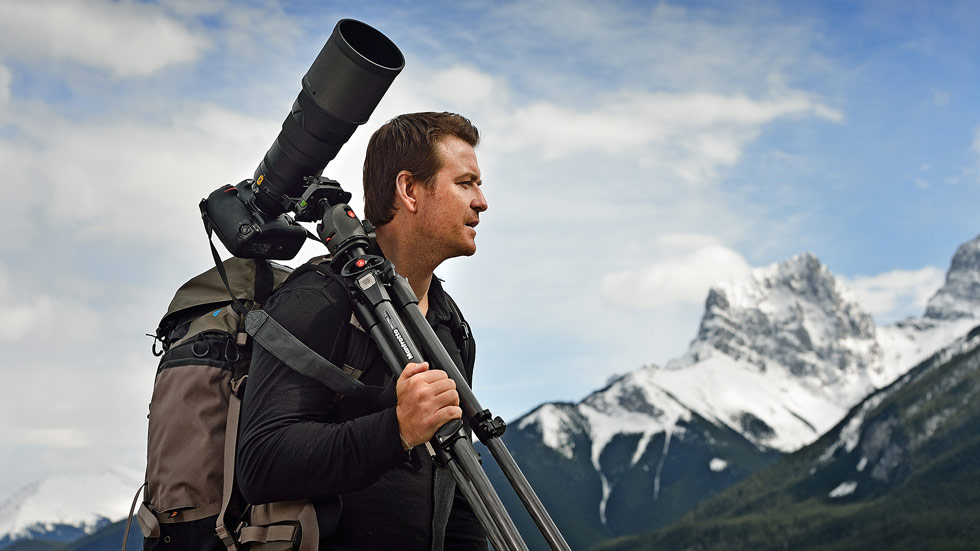
The NIKKOR Z 70-200mm f/2.8 VR S II Hits the Sweet Spot for Portraiture and Wedding Photography
The NIKKOR Z 70-200mm f/2.8 VR S II lens offers many advantages over the first generation of that focal length for Z series mirrorless cameras. It’s lighter, smaller, has faster autofocus and better subject tracking. There’s also a closer focusing distance—15 inches rather than 19.7 (at 70mm) and improved bokeh that closes in on prime-lens quality.
All of the above was important to Nikon Canada Ambassador Sean LeBlanc, who specializes in upscale family portraiture and wedding photography. Right from the start he knew that this lens hit the sweet spot for both, but what was particularly interesting to us was the point at which he became really excited about the lens.
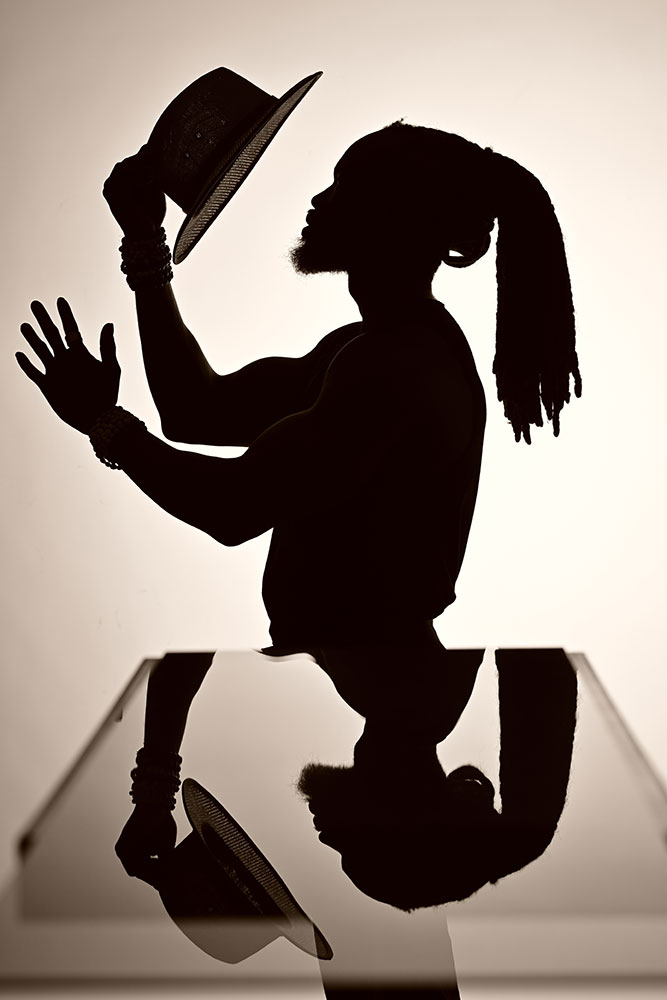
“I’ve always been drawn to silhouettes—the bold look, the bright/dark contrast. Here I added some reflection and used the zoom to fine-tune the framing as I went along.” Z 9, NIKKOR Z 70-200mm f/2.8 VR S II, 1/160 second, f/5.6, ISO 200, manual exposure.
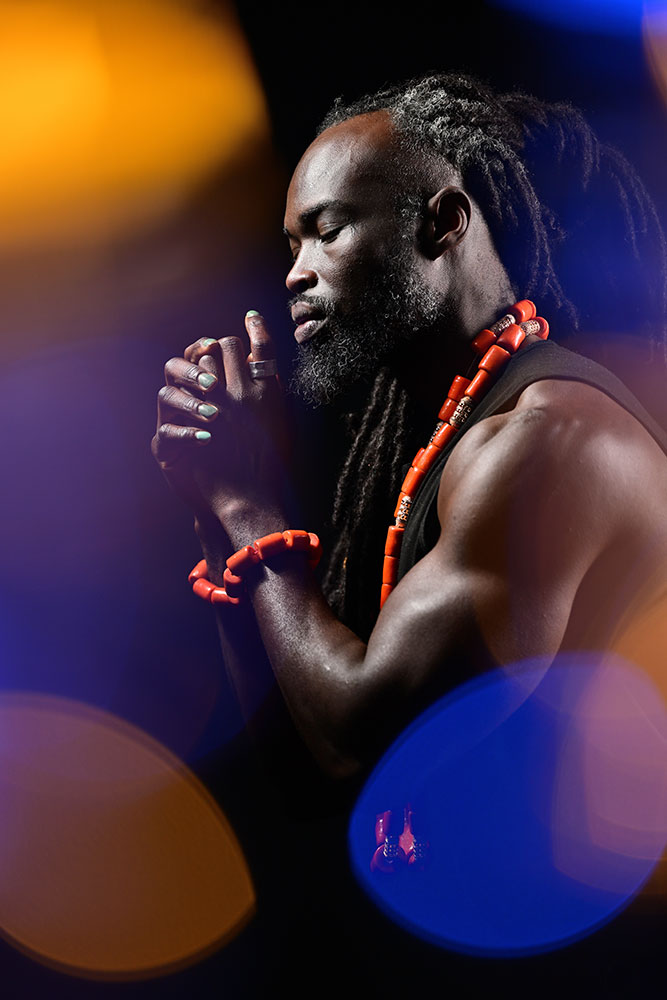
“I added the foreground bokeh balls by lining up wine glasses on a table and shooting with flash on both sides, one with a blue gel, the other an orange-toned gel, aimed at the glasses. I shot wide open to get the large bokeh size. That lens is incredibly sharp wide open.” Z 9, NIKKOR Z 70-200mm f/2.8 VR S II, 1/160 second, f/2.8, ISO 100, manual exposure.
“I shoot with that focal length all the time,” he says, “so I’m very familiar with it, both in the studio and on location, so I felt the weight difference right away—it’s noticeably lighter [than the first generation] and a bit smaller, with a very smooth focusing ring, but I was most excited about the lens when I reviewed the photographs I’d taken on my first day of shooting.”
That’s where the “right out of the camera” factor kicked in.
“I was using Nikon NX Studio software, and the files I was seeing were incredibly sharp, but it was more than that. There was a beautiful presence to them—a look of silkiness—and the colours and skin tones were outstanding. These were essentially images I could use right out of the camera; they required very little tweaking. Being able to create imagery like that is an incredible benefit, and that’s what this lens delivered. I was really impressed.”
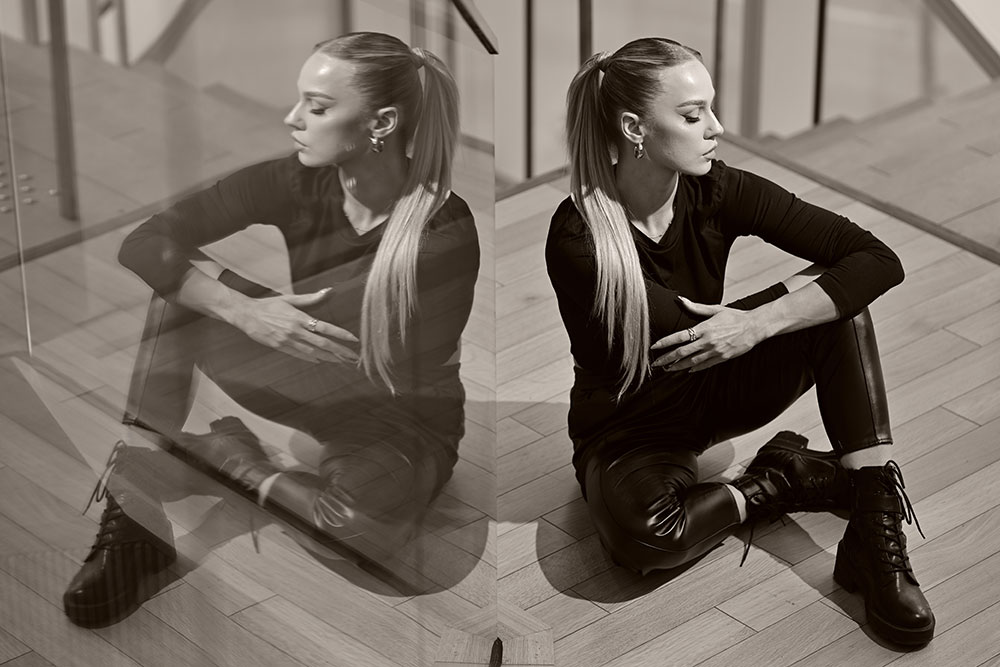
Sean’s observation of a local library’s staircase and glass railing led to this image. “I was able to use the zoom to properly frame everything to create the reflection. I used the Z 9’s sepia-tone setting, so this is pretty much right out of the camera.” Z 9, NIKKOR Z 70-200mm f/2.8 VR S II, 1/160 second, f/3.5, ISO 200, manual exposure.
There were also what he called “little nuances,” like the Arca Swiss connection to his studio tripod. And the ability to focus a little bit closer to his portrait subjects. He also mentioned ease of handling. “I shoot with a Z 9, and there was a nice, comfortable balance when I was shooting on location and hand-holding the lens.”
Though Sean uses prime NIKKOR lenses for wedding ceremonies and bride and groom portraits, he says the NIKKOR 70-200mm f/2.8 VR S II is going to be part of his kit for certain wedding situations because that’s where the larger compression of the 70-200mm has the edge over the primes. And the lens rivals prime results when it comes to bokeh. “With lights in the foreground or background, I was getting a beautiful, silky-smooth bokeh effect.”
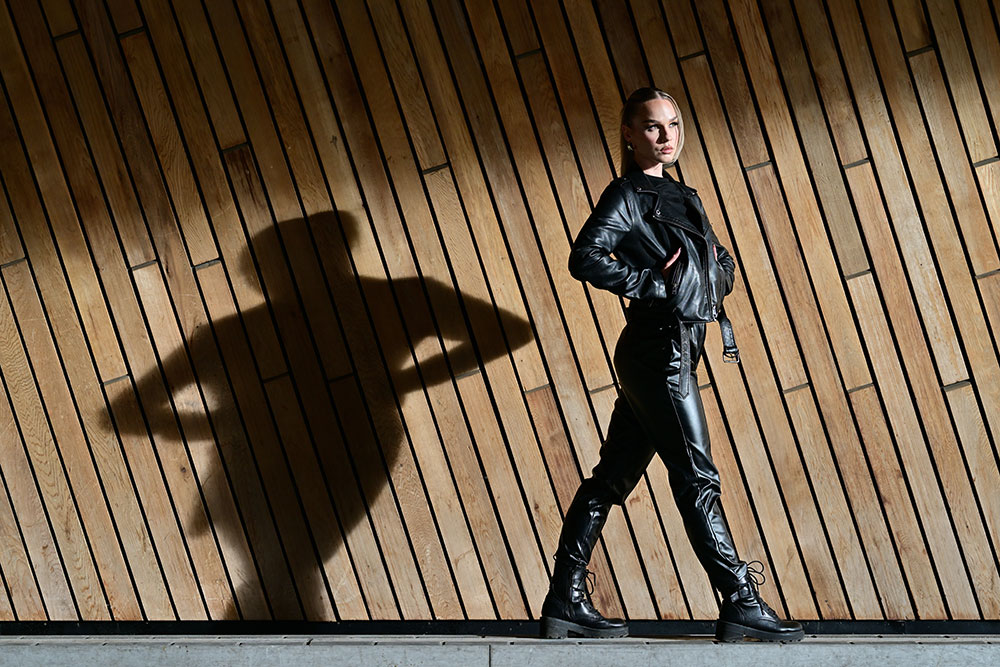
Mid-afternoon sun and a large overhang gave Sean this “sort-of triangular” shadow on the wood wall. The zoom choices for framing were invaluable here. Z 9, NIKKOR Z 70-200mm f/2.8 VR S II, 1/400 second, f/5.6, ISO 400, manual exposure.
…the files I was seeing were incredibly sharp, but it was more than that. There was a beautiful presence to them—a look of silkiness—and the colours and skin tones were outstanding.
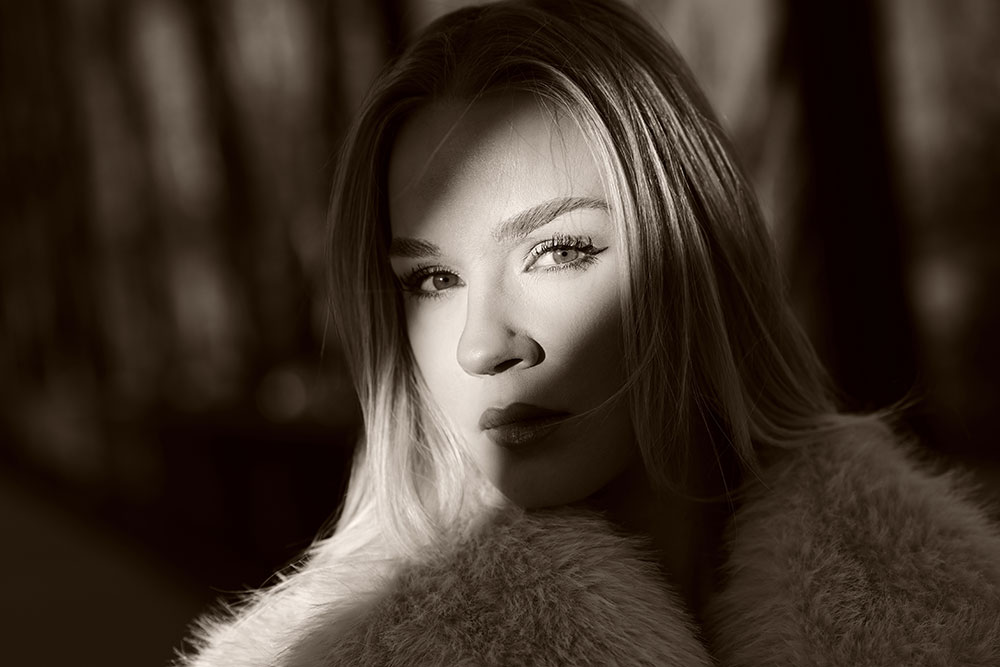
“The sun coming through the iron framework of the Canmore Engine Bridge created the strips of light. As she walked toward me, that light hit her eyes and lit them. I balanced the exposure so the strip was perfectly exposed, which underexposed the rest of the scene.” Z 9, NIKKOR Z 70-200mm f/2.8 VR S II, 1/1600 second, f/3.5, ISO 200, manual exposure.
A Perfect Fit
Sean’s photography is driven by ideas, imagination and observation; you’ll see that in the images at his website and in the photos here (above), which are among the first ones taken with the lens. You’ll see a glass railing in a local library that became the site for an intriguing reflection image. In Sean’s studio a piece of glass and an imaginative setup created a free-form silhouette. Outdoors he framed an image that made the most of angled sunlight and the graphics of a wood wall to provide his subject with an alternate shadow.
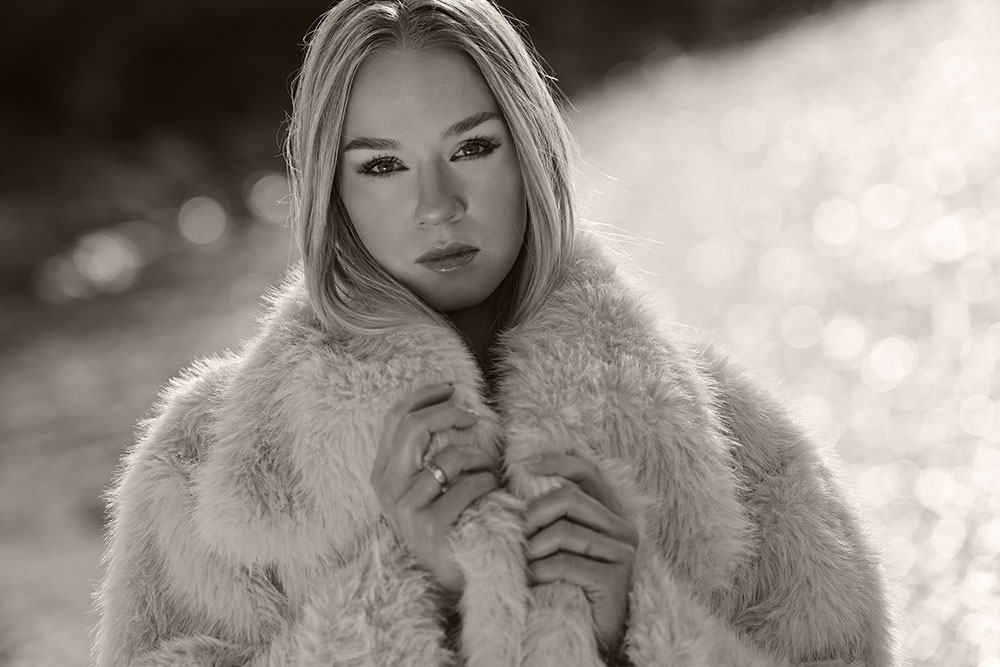
Direct sunlight made it hard to photograph at the river under the Canmore Engine Bridge. A reflector created the catchlight in the model’s eyes and filled in some shadows on her face. Bokeh turned reflections coming off the water into soft circles. “I really needed the fast AF because it was hard for her to keep her eyes open—it was a ‘look at me quickly’ picture.” Z 9, NIKKOR Z 70-200mm f/2.8 VR S II, 1/3200 second, f/4, IS0 200, manual exposure.
Throughout the shoots, the fast-focusing capability of the lens quickly turned on-the-spot decisions into realized images. Overall, the lens was perfectly suited to a photographer who requires versatility equal to his own.
“What I aim for is an elegant and timeless feel to the portraits created in the studio,” Sean says. On location, his wedding photography is often spontaneous, prompted by the graphic possibilities of the setting. In both situations he relies on his gear to fulfill the potential of his ideas and imagination.
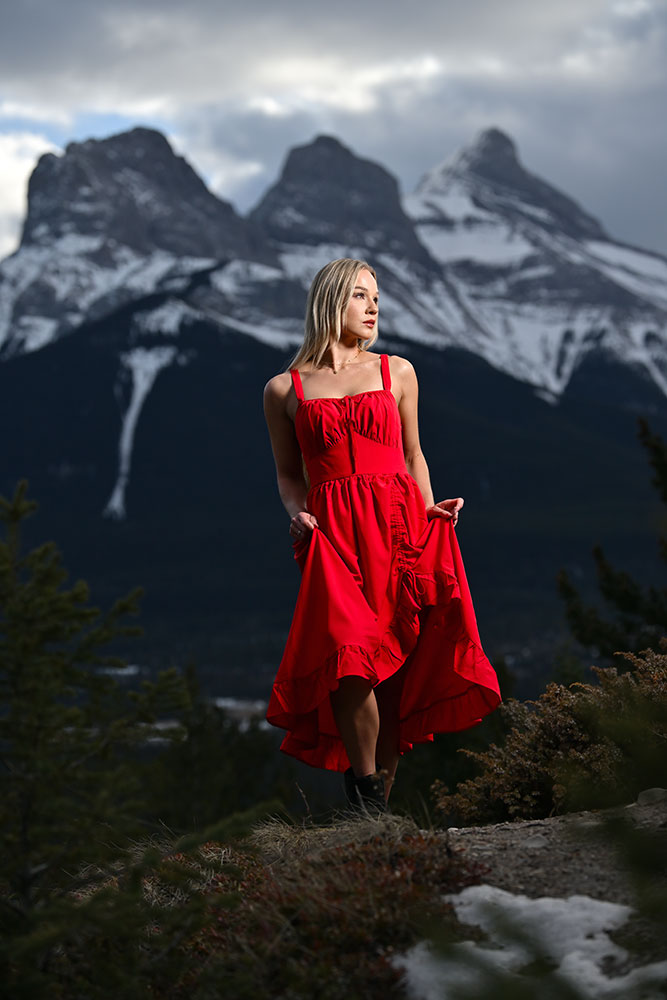
Taken late in the afternoon with a Profoto B30 flash in a small strip box to camera right, tilted down. “With this framing I was able to bring out details of the clouds and mountains. The red dress gave the image the attention-getting, standout element I wanted.” Z 9, NIKKOR Z 70-200mm f/2.8 VR S II, 1/4000 second, f/3.5, ISO 200, manual exposure.